The dining room looks smart and the agent says the previous tenant traded without problems. However, none of that confirms what sits below the floor. A damaged drain, grease-lined pipe or inaccessible chamber can delay opening and disrupt trade after you sign.
A commercial drain survey in Kingston provides evidence before you commit. It can show the accessible drainage layout, record the pipe condition and identify faults that deserve further discussion with the landlord. It does not replace legal or building advice, but it gives your advisers information they cannot get from a viewing alone.
The short answer: inspect first, negotiate second, fit out third
Ideally, arrange the drainage inspection while you can still negotiate the lease and before new floors, counters or kitchen equipment restrict access.
The findings may help you:
- identify pre-existing defects and restrictions;
- locate shared or hidden drainage routes;
- plan cleaning or repairs before opening; and
- retain a dated record for lease discussions and handover.
Repair responsibility depends on the lease, the part of the system affected and other facts. Therefore, give the drainage report to your solicitor and commercial building surveyor rather than assuming either the landlord or tenant must pay.
Why a normal property viewing may miss drainage trouble
Commercial viewings concentrate on the visible space. A sink may empty during a brief test despite a downstream restriction. Moreover, vacant drains have not carried a normal trading load, and old plans may not show later alterations, redundant branches or hidden chambers.
What should a pre-lease commercial drain survey check?
The right scope depends on the property and your proposed use. Nevertheless, a useful inspection should address the following points.
1. The route of the drains
Establish where accessible foul and surface-water drains run. Note the flow direction, chambers and connections serving neighbouring premises.
This matters in Kingston town-centre parades, converted buildings and mixed-use properties, where several units may share a drain run. Our guide to drain mapping in Kingston explains how CCTV and tracing can build a clearer picture when reliable plans are missing.
Mapping does not decide legal ownership, but it gives advisers a practical layout to compare with lease plans and searches.
2. The internal condition of accessible pipework
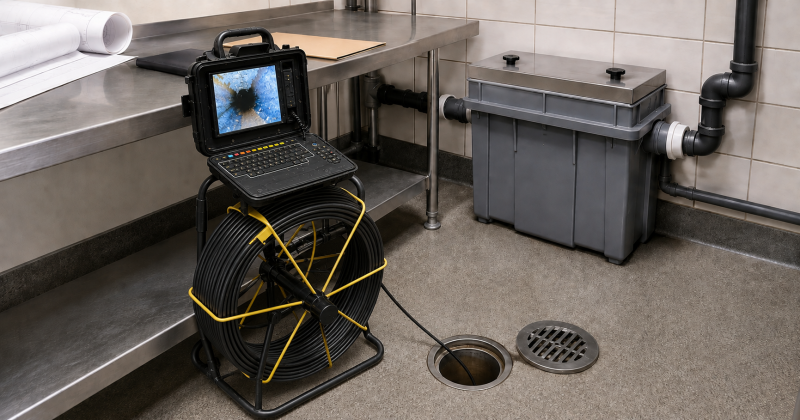
A commercial CCTV drain survey can reveal defects that nobody can assess from floor level. Depending on access and visibility, the camera may identify:
- cracked or fractured pipes;
- displaced or open joints;
- deformation or partial collapse;
- root ingress;
- scale, grease or silt reducing the bore;
- standing water that may indicate a poor fall; and
- redundant branches or unexpected connections.
The report should identify every inspected section and any point the camera could not pass.
3. Grease and food deposits
Fats, oils, grease and food particles can coat restaurant drains even while wastewater still moves. Ask what grease-management system the previous business used and request its service records. Thames Water’s best-practice guidance for food businesses explains the related blockage, hygiene and legal risks, alongside relevant Building Regulations guidance.
Heavy grease may hide the pipe wall. Therefore, the contractor may need to clean the drain before assessing its condition.
4. Capacity for the proposed fit-out
A survey can locate routes and record visible pipe sizes, but it cannot prove that the system will accept every proposed appliance or a higher trading load.
For new sinks, dishwashers, gullies, toilets or a grease separator, involve the relevant designer, contractor, landlord and approving bodies. They must assess capacity, gradients, ventilation, connections and permissions against the fit-out.
5. Access for future maintenance
Find accessible chambers and rodding points before agreeing the kitchen plan. Restricted access can turn routine clearance into disruptive work. Do not cover a chamber or build over a drain without appropriate advice and consent. For shared access, clarify entry and reinstatement arrangements.
6. Surface water and external gullies
Check external gullies, yards, loading areas and rainwater routes too. Leaves, silt and poor falls can cause ponding, while contaminated wash-water must not enter a surface-water drain. Where connections remain uncertain, confirm them through dye testing or further investigation.
7. A clear starting-condition record
Request dated footage, still images, a written summary and, where instructed, a drainage plan. The report should locate material defects and distinguish observations from recommendations.
This evidence can complement a wider Schedule of Condition. RICS advises tenants to understand dilapidations before signing and to append any contractual condition record beforehand. Read the RICS dilapidations guide, then ask your solicitor and surveyor how to record the drainage findings.
What a CCTV drain survey cannot promise
A report records what was accessible and visible that day. It cannot guarantee every hidden branch has been found or that a clear pipe will never block.
Common obstacles include:
- missing, seized or unsafe access covers;
- grease, silt or standing water obscuring the pipe;
- tight bends or reductions that stop the camera;
- private areas to which access was not granted;
- pumps, interceptors or specialist equipment outside the agreed scope; and
- drainage beyond the inspected boundary.
Get limitations in writing. You may also need a building survey, drainage search, fit-out design, grease assessment or legal review.
Drainage red flags before taking a Kingston unit
Pause and investigate if you find any of the following:
- persistent odours in a vacant unit;
- several slow fixtures rather than one isolated sink;
- fresh sealant or patch repairs around drainage points;
- water marks near low-level cupboards or floor gullies;
- missing grease-management records;
- an interceptor with no clear servicing history;
- chambers hidden under fixtures or finishes;
- different accounts of where the drains run;
- repeated unblocking invoices without a diagnosis; or
- a landlord unwilling to allow reasonable inspection.
None automatically makes the premises unsuitable. Each one does, however, justify evidence before commitment.
What to ask the landlord or agent
Send these questions in writing:
- May we inspect all drainage access points before signing?
- Are any drains, chambers, stacks or grease systems shared?
- Who serviced the grease equipment, and when?
- Have there been blockages, flooding, odours, leaks or repairs?
- May we see earlier reports, invoices, plans and warranties?
- Who is responsible for private, shared and common drainage?
- Will the landlord repair recorded defects before completion?
- Who pays for cleaning, emergencies and blockage damage?
- What permissions do new kitchen connections require?
- Can the findings be referenced in the Schedule of Condition or lease?
Do not rely solely on verbal replies. Your solicitor should check that the final documents reflect each agreement.
If the survey finds a problem
A defect does not always end the deal. Instead, it creates a decision point while terms remain negotiable. You might ask the landlord to clean and re-survey the line, complete specified repairs, improve access or agree who will meet each cost before fit-out.
For proposed repairs, obtain a clear scope based on the evidence. Kingston Drains24 provides drain repairs in Kingston upon Thames, including no-dig options where the pipe condition and access make them suitable.
Afterwards, request completion evidence. A final camera pass can provide a useful handover record.
Book the survey before the unit becomes your problem
Rent, rates and fit-out costs are obvious. Drainage is easy to overlook until it interrupts trade. If you are considering a restaurant, café, shop, office or other unit in Kingston, Surbiton, Norbiton, New Malden, Berrylands, Coombe, Tolworth or Kingston Vale, arrange the inspection before signing where possible.
Kingston upon Thames Drains24 can inspect accessible pipes, record defects and trace routes. Call 020 8143 8933 for a survey quote or 07511 181 177 for an urgent drainage problem.
This article offers general drainage information, not legal, lease, building-control or food-hygiene advice. Ask appropriately qualified advisers to review the premises, proposed use and lease terms.
Frequently asked questions
Should I arrange a commercial drain survey before signing a Kingston lease?
Where drainage condition, layout or repair liability could affect your decision, arrange the survey before signing. This gives you time to investigate defects, discuss works and brief your advisers while the parties can still negotiate.
What does a commercial CCTV drain survey include?
The agreed scope may include camera inspection of accessible pipes, defect images, footage, condition notes and recommendations. When routes remain unclear, add drain tracing or mapping. Confirm the access points, deliverables and exclusions before booking.
Does a clear CCTV survey prove the drains can handle a new restaurant?
No. CCTV primarily records visible condition inside accessible pipes. Proposed kitchen loading, pipe capacity, grease management, ventilation, gradients and connection permissions may need separate design and compliance checks.
Can a drain survey show who must pay for repairs?
It can show the visible fault and its location, but it does not decide legal responsibility. Liability may depend on the lease, drainage ownership, shared arrangements and the cause of the defect. Ask your solicitor to interpret the evidence.
Should grease-covered drains be cleaned before the survey?
Often, yes. Heavy grease or debris can hide cracks and joints from the camera. An initial inspection may identify the restriction, after which cleaning and a second camera pass can provide a clearer assessment.
Can drainage findings form part of a Schedule of Condition?
They can provide useful supporting evidence. However, ask a commercial building surveyor and solicitor how the lease should record, reference and append the findings.