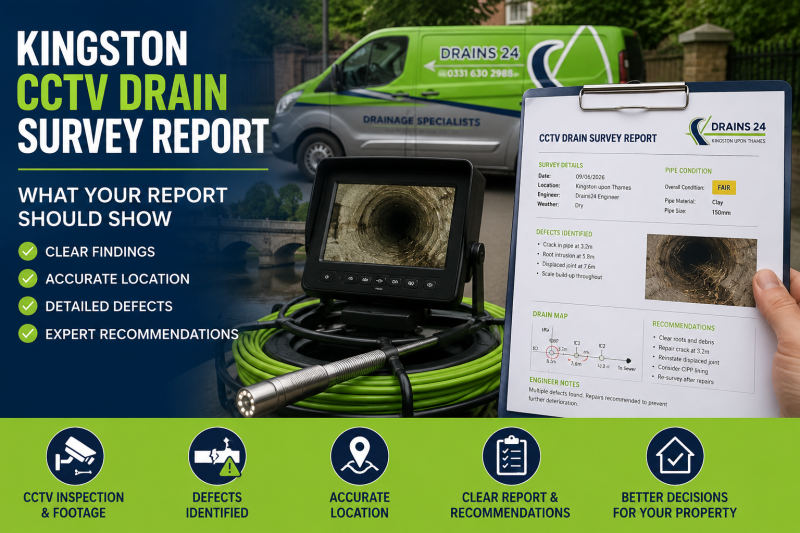
A Kingston CCTV drain survey report should do more than confirm that a camera has been put into the drain. It should help you understand the condition of the pipework, where any faults are located, and what action may be needed next.
For homeowners, buyers, landlords and businesses in Kingston upon Thames, a clear report can make drainage decisions much easier. It can support repair planning, property purchases, insurance discussions, building work, drainage mapping and repeat blockage investigations.
Kingston upon Thames Drains24 helps customers inspect underground drainage systems properly, especially where drains keep blocking, smells return, repairs are being considered, or the pipe layout is unclear.
Why a Kingston CCTV drain survey report matters
Drainage problems can be difficult to judge from the surface. A drain may look clear from above while a cracked pipe, root entry point, poor fall or displaced joint sits underground. Without a clear report, customers may only know that a blockage happened, not why it happened.
A good report gives context. It should show what the camera found, where the issue sits, and whether the drain needs cleaning, monitoring, repair or further investigation.
This is why a CCTV drain survey is often useful before drain repairs, property purchases, renovation work or repeated unblocking visits.
What should be included in the report?
A useful CCTV drain survey report should present the findings clearly. It does not need to overwhelm the customer with jargon, but it should give enough detail to support a sensible decision.
The report may include:
- The sections of drainage inspected.
- The access points used, such as inspection chambers.
- The pipe material, size and general condition where visible.
- Defects such as cracks, displaced joints or root ingress.
- Evidence of standing water, silt, scale or debris.
- Photos or still images from the CCTV footage.
- A summary of the problem and its likely impact.
- Recommendations for cleaning, repair, lining or replacement.
- Drain mapping notes where the layout needs recording.
The aim is to turn hidden pipework into understandable evidence.
Pipe condition and visible defects
The report should explain the general condition of the pipe. This may include whether the drain appears sound, worn, scaled, cracked, misaligned or partly blocked.
Common defects include:
- Cracked pipe sections.
- Open or displaced joints.
- Tree roots entering the pipe.
- Pipe scale reducing the bore.
- Silt or debris collecting in low sections.
- Signs of pipe deformation or collapse.
- Poor gradients causing standing water.
These details help explain why a drain blocks, smells, runs slowly or causes damp patches outside.
Where the problem is located
A strong report should not only say what the fault is. It should also help locate it. This matters because accurate location can reduce unnecessary digging and make repair planning more precise.
For example, a root entry point near an inspection chamber may need a different repair approach from a damaged pipe below a driveway or extension. If the fault is in a shared line, responsibility may also need checking before work starts.
Clear location notes help customers understand the next step and avoid guesswork.
Photos, footage and still images
Photos and footage make a report easier to understand. Still images can show the exact issue, such as a cracked joint, root mass, displaced pipe section or heavy build-up.
For customers, visual evidence is useful when discussing the problem with property buyers, landlords, insurers, contractors or neighbours. It also helps explain why a repair has been recommended.
The report should not rely only on technical wording. Images can make the findings clearer and more transparent.
Drain mapping and layout notes
Some Kingston properties have older drainage layouts, shared runs, extensions, converted flats, commercial changes or poorly recorded pipe routes. In these cases, survey findings can help build a better understanding of the system.
Drain mapping notes may show where inspection chambers sit, how pipes connect, which way the flow travels, and where important junctions or defects are located.
This can be especially useful before renovation work, landscaping, extensions, resurfacing or planned drainage repairs.
Repair recommendations
A survey report should explain whether repair work is needed and what type of option may suit the fault. It should not simply say “repair required” without context.
Possible recommendations may include:
- Further cleaning or jetting.
- Root cutting and monitoring.
- Patch repair for a localised defect.
- CIPP lining where the pipe is suitable.
- Excavation where the pipe has collapsed or moved badly.
- Drain replacement where repair is not practical.
For customers dealing with drain repairs, the report should help explain why a particular option is being suggested.
When a CCTV survey follows drain unblocking
A CCTV survey is not always needed after a simple blockage. If the cause is clear and the drain runs normally after clearing, further investigation may not be necessary.
However, a survey becomes useful when the same drain blocks again, water still drains slowly, bad smells return, or the engineer suspects damage inside the pipe.
In these cases, drain unblocking solves the immediate problem, while CCTV inspection helps explain why the issue happened.
When roots are found during the survey
Tree roots can enter drains through small cracks, open joints or weak seals. Once inside, they catch waste and slow the flow.
A report should show where roots have entered and whether the problem looks minor, moderate or serious. It should also explain whether root removal, repair work or ongoing monitoring may be needed.
If roots keep returning, the entry point usually needs attention. Otherwise, the drain may block again even after cutting or jetting.
Why certified drainage survey work matters
For homebuyer surveys and formal drainage checks, the quality of the report matters. The National Association of Drainage Contractors explains that certified drain surveyors can provide reports covering structural condition, misconnections, ownership, mapping and other important drainage findings. NADC guidance on homebuyer drain surveys is a useful reference for understanding why proper reporting and survey competence are important.
Even when the survey is not for a property purchase, the same principle applies. A report should be clear enough to help the customer make a practical decision.
What customers should ask before booking
Before booking a CCTV drain survey, it is worth asking what you will receive afterwards. A clear expectation helps avoid confusion.
Useful questions include:
- Will the survey include a written summary?
- Will defects be explained clearly?
- Can photos or still images be provided?
- Will the report identify likely repair options?
- Can the survey help with drain mapping?
- Will the engineer explain the findings after inspection?
These questions help ensure the survey gives you usable information, not just footage.
A good report should help you decide what to do next
The most useful CCTV report is one that turns hidden drainage problems into clear next steps. It should explain what was seen, where it was found, how serious it appears, and what action may be sensible.
Kingston upon Thames Drains24 can help with CCTV drain surveys, blocked drains, root removal, drain repairs and drainage investigation across Kingston and nearby areas.
If you need a CCTV survey, make sure the final report gives you the detail needed to move forward with confidence.
FAQs
What should a Kingston CCTV drain survey report include?
It should include the areas inspected, pipe condition, visible defects, location notes, images or footage where available, and recommendations for cleaning, repair, lining or further investigation.
Do I need a CCTV survey after every blocked drain?
No. A simple one-off blockage may not need a survey. However, CCTV inspection can help when the same drain blocks again, smells return, water drains slowly or pipe damage is suspected.
Can a CCTV survey report help with drain repairs?
Yes. A report can show the fault, location and severity of the damage. This helps decide whether patch repair, lining, excavation, root removal or cleaning is the right next step.
Does a CCTV survey show tree root damage?
Yes. CCTV footage can show roots entering the pipe, where they enter and how much they are affecting the drain. This helps decide whether root removal or repair work is needed.
Can CCTV survey reports help before buying a property?
Yes. A CCTV survey can show hidden drainage defects before purchase. This can help buyers understand the condition of the drains before making final decisions.